13162017139

Note: Application as IHC, only suitable for histochemical staining or fluorescence staining of paraffin-embedded sections. Application as ICC/IF, suitable for histochemical or fluorescent staining of frozen sections, as well as chemical and fluorescent staining at the cellular level.
注意:抗体应用为IHC的,抗体只适合于石蜡切片的组化染色或者荧光染色。
抗体应用为IF/ICC的,抗体适合于冰冻切片的组化染色或者荧光染色,以及细胞水平的化学染色和荧光染色。
ABMART实验方案下载
Green Fluorescent Protein (GFP) was initially discovered as a protein during the bioluminescence process of the Aequorea victoria jellyfish. When the complementary DNA (cDNA) of GFP is expressed in prokaryotic cells, it can produce fluorescent products without the need for exogenous substrates or cofactors. This characteristic makes it a practical tool for monitoring gene expression and protein localization in the body. GFP is commonly used as a fusion protein tag in expression vectors. By fusing it with an exogenous protein, it enables the monitoring of the expression of the fused exogenous protein.
IP
All Species Expected
Transfected Only
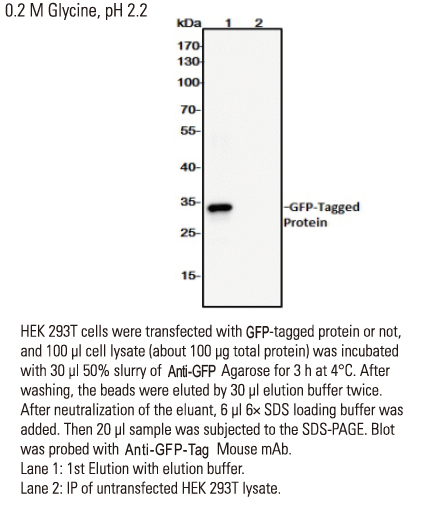
Anti-GFP Tag mAb
IP 1:50
Mouse IgG1
The product is supplied as a 50% slurryin storage buffer(1×PBS,pH7.4,containing0.1%NaN).
The beads are recommended to be stored at 4℃. The product is stable for 12 months at 4℃. Freezing the magnetic beads will irreversibly damage the bead structure.
Lysis buffer (IP、CoIP):10mM Tris-HCl pH 7.5;150mM NaCl;0.5mM EDTA;0.5% NP-40
RIPA buffer:10mM Tris-HCl pH 7.5;150mM NaCl;0.5mM EDTA;0.1% SDS;1% Triton X-100;1% Deoxycholate
Dilution/Wash buffer:10mM Tris-HCl pH 7.5;150mM NaCl;0.5mM EDTA
2×SDS loading buffer:120mM Tris-HCl pH 6.8; 20% glycerol; 4% SDS, 0.04% bromophenol blue; 10%β-mercaptoethanol
| Eluent | Prefer | Typical use | Neutralization (per 100 μL eluate) | Notes |
|---|---|---|---|---|
| 1× SDS loading buffer 95 °C | Special | WB/MS only | None needed | Protein denatured |
| 0.2 M Glycine pH 2.5 | ★ First-line | High yield, WB/MS/Ig prep | 50 μL 1 M Tris-HCl pH 8.0 | Neutralize immediately |
| 0.1 M Glycine pH 3.0-3.5 | Alternative | Preserve activity, functional assays | Same as above | 5-15% lower yield |
| 2-3 M MgCl₂ or 3-5 M NaSCN | Alternative | Acid-sensitive proteins | Desalt at once (spin column) | High salt interferes downstream |
| 50 mM NaOH pH 11-12 | Rare | Alkali-tolerant proteins | 50 μL 1 M Tris-HCl pH 7.4 | Beads single-use |
AB_2936243
1. Experimental Preparation
Use 1.5mL microcentrifuge tubes or spin columns as experimental vessels.
Vortex or invert the tube or vial containing Anti-GFP agarose thoroughly to achieve complete resuspension of the beads.
2. Sample and Agarose Incubation
Using a wide-bore pipette tip, add 20–50μL of 50% (v/v) agarose suspension to the cell lysate.
Note: The lysis buffer (10mM Tris-HCl, pH7.5; 150mM NaCl; 0.5mM EDTA; 0.5% NP-40) should be freshly prepared. For samples expressing high levels of tagged protein, 200μL of lysate (containing 200-500μg total protein) typically yields optimal immunoprecipitation (IP) results. It is recommended to include a protease inhibitor cocktail (e.g., catalog no. A10004: 200×Protease Inhibitor Cocktail) in the lysis buffer.
3. Binding Incubation
Incubate the mixture gently on a rotator or shaker at 4℃ for 3-4 hours or overnight to ensure efficient binding between the antibody and the target protein.
4. Agarose Bead Washing
Wash the agarose beads with 1 mL of wash buffer (10mM Tris-HCl, pH7.5; 150mM NaCl; 0.5mM EDTA; 1% NP-40; 0.5% sodium deoxycholate). Alternatively, 1×PBST (0.05% Tween-20) may be used.
Centrifuge at 2000×g for 3 minutes, carefully remove the supernatant, and repeat the washing step three times. Avoid disturbing or losing the agarose bead pellet during aspiration.
5. Target Protein Elution (Choose One of the Following Methods)
Option 1: Acid Elution
Add 30–50μL of acidic elution buffer to the washed beads and mix gently by tapping. Immediately centrifuge at 2000×g for 3 minutes and transfer the supernatant to a fresh tube, taking care not to carry over any agarose beads.
Note: Neutralize the eluate immediately by adding 1μL of 1.5 M Tris-HCl (pH 9.0) per 20 μL of elution buffer.
Option 2: SDS Loading Buffer Elution
Add 30μL of 2×SDS-PAGE loading buffer to the beads and mix thoroughly. Heat the sample at 100°C for 5 minutes to elute bound proteins. Centrifuge at 2000×g for 3 minutes and transfer the supernatant to a new tube.
Note: This method results in co-elution of the target protein along with antibody heavy and light chains (IgG).
6. Downstream Applications
Proceed with SDS-PAGE and Western blotting, or other appropriate analytical methods, for detection and analysis of the eluted protein.


艾比玛特医药科技(上海)有限公司
上海市徐汇区桂平路333号聚科生物园区1号楼1-3层
邮箱:market@ab-mart.com
应聘职位:hr@ab-mart.com
订购专线:4006-123-828
销售电话:13916964679(微信同号)
技术支持:15618194176(微信同号)
华南经销商负责(广东,广西,福建,海南):
程经理:手机18616261485(微信同号)
华北经销商负责(北京,天津,河北):
徐经理:手机15618191473(微信同号)
南方经销商负责:
陆经理:手机13122837132(微信同号)
北方及西南经销商负责:
张经理:手机13122150513(微信同号)

微信客服
邮箱:market@ab-mart.com
应聘职位:hr@ab-mart.com
订购专线:4006-123-828
销售电话:13916964679(微信同号)
技术支持:15618194176(微信同号)
华南经销商负责(广东,广西,福建,海南):
程经理:手机18616261485(微信同号)
华北经销商负责(北京,天津,河北):
徐经理:手机15618191473(微信同号)
南方经销商负责:
陆经理:手机13122837132(微信同号)
北方及西南经销商负责:
张经理:手机13122150513(微信同号)
微信客服
沪ICP备17056956号-2 艾比玛特医药科技(上海)有限公司